Parque Nacional Los Glaciares · Argentina

El Chaltén

Argentina's trekking capital

A village at the end of the road, at the foot of the Andes, where the trails begin directly from the street. No buses, no permits, no entrance fees. Just mountains, glaciers, and the silence of the Patagonian steppe.

3,405 Metres
Fitz Roy summit
200+ Km of marked
trails, all free
726K Ha protected
UNESCO heritage
1985 Year the village
was founded

The destination

A village that exists
entirely for the mountains

El Chaltén was founded in 1985 — not to serve a mine, not to anchor a trade route, but as an act of territorial assertion. Argentina planted a village in the wilderness to reinforce its claim to the land. What grew there, almost by accident, was one of the finest trekking destinations on earth.

The village sits at 400 metres above sea level, on the banks of the Río de las Vueltas, where the Patagonian steppe meets the eastern face of the Andes. To the west, the granite towers of the Fitz Roy massif rise abruptly from the treeline. To the east, the steppe stretches for hundreds of kilometres — flat, windswept, vast.

Every trail in El Chaltén begins at the village edge. You walk out of your accommodation and into the park. There are no entrance fees, no shuttle buses, no booking systems. This is an unusual and precious thing in 2026, and it is central to what makes El Chaltén different from every other mountain destination.

"The trails here leave directly from the village. No buses, no park fees, no permits."

The Fitz Roy massif — known to the Tehuelche people as Chaltén, meaning "the smoking mountain" for the clouds that perpetually crown its summit — rises to 3,405 metres and was first summited in 1952 by Lionel Terray and Guido Magnone. Today it is one of the most photographed peaks in the world, visible from the main street of the village on clear days.

The season runs from October to April. In winter, the hotel closes and the village quiets down to a few hundred permanent residents. But from late spring through autumn, El Chaltén becomes what it was always meant to be: a base camp for the mountains.
Trekking

The trails

All trails in El Chaltén are free of charge, open year-round, and well signposted. They depart directly from the village — no transport required. Upon arrival in El Chaltén, register at the park entrance (no fee, takes two minutes) and pick up a free trail map.

Weather in Patagonia changes rapidly. Check conditions each morning at the park office. Most experienced trekkers plan each day the evening before, using the forecast rather than a fixed itinerary.

✓  All trails free · No permits required

Laguna de los Tres — Fitz Roy

The essential circuit. The one everyone comes for.

A full-day return walk through lenga beech forest to the glacial lake at the base of the Fitz Roy massif. The final ascent — steep, exposed — rewards with a view that is genuinely difficult to prepare for: the Fitz Roy reflected in the turquoise water of the lagoon. One of the great walks of the world.

22 km return 7–9 hrs Moderate–demanding
800
m elevation
gain

Laguna Torre — Cerro Torre

Towards the needle. The other essential day walk.

A full-day return through the Río Fitz Roy valley to the lake below Cerro Torre — the spire that Reinhold Messner once called "a shout turned to stone." The approach through the forest, the emergence onto the glacier moraine, and the first view of the tower are a distinct and memorable sequence.

18 km return 6–7 hrs Moderate
350
m elevation
gain

Loma del Pliegue Tumbado

The panoramic. The overlooked classic.

A sustained ascent to a ridge where both the Fitz Roy and Cerro Torre groups are simultaneously visible — along with the Viedma glacier, the steppe to the east, and on clear days, the ice cap itself. Less visited than the lakeshore routes. Often the most satisfying day walk in El Chaltén.

14 km return 5–6 hrs Demanding
1,100
m elevation
gain

Laguna Capri

The afternoon walk. Perfect for the first day or for families.

A gentle half-day return that reaches a small glacial lake with clear views of the Fitz Roy massif. The best introduction to the terrain, and ideal for those arriving in the afternoon or travelling with children. The views from Capri are, in good light, almost as dramatic as those from Laguna de los Tres.

7 km return 2.5–3.5 hrs Gentle
300
m elevation
gain

Mirador de los Cóndores

Short, sharp, spectacular. Ideal add-on for any day.

A steep 40-minute climb above the village to a viewpoint overlooking the Río de las Vueltas valley, the Lago del Desierto road, and the mountains to the north. Often combined with the Mirador de los Aguilas. A classic first or last walk of a stay.

4 km return 1.5–2 hrs Gentle
250
m elevation
gain

Huemul Circuit

The multi-day classic. For experienced trekkers only.

A four-day loop around the Huemul glacier, involving a hand-cable river crossing, technical terrain, and remote campsites. One of the most demanding and rewarding multi-day routes in Patagonia. Requires prior experience with navigation, river crossings, and carrying full camping equipment. Permit required.

60 km loop 4 days Expert · Permit required
2,400
m total
elevation gain

Trail maps and conditions

Free paper maps are available at the park entrance (CHALTEN TRAVEL office at the village entrance). For digital maps, Wikiloc and AllTrails have reliable GPS tracks for all routes. Check the park office daily for weather conditions and trail closures — river levels can change quickly after rain.

The national park

Parque Nacional Los Glaciares

UNESCO Natural World Heritage since 1981. The largest national park in Argentina.

Parque Nacional Los Glaciares covers 726,927 hectares of the southern Patagonian Andes — making it the largest national park in Argentina and one of the most significant protected areas in South America. It was declared a UNESCO Natural World Heritage Site in 1981 for its extraordinary concentration of glaciers, ice fields, and mountain ecosystems.

The park is divided into two sectors. The southern sector, centred on El Calafate, is home to the Glaciar Perito Moreno — the world's most accessible advancing glacier and one of Argentina's defining natural icons. The northern sector, centred on El Chaltén, is the domain of the Fitz Roy and Cerro Torre massifs, surrounded by the vast ice sheet of the Southern Patagonian Ice Field — the third largest freshwater reserve on the planet after Antarctica and Greenland.

The park sits on the border with Chile, where it connects with Torres del Paine National Park — making the combined area one of the most extraordinary protected wilderness regions on earth. The Patagonian Ice Field extends across both countries, feeding glaciers that flow east into Argentina and west into Chilean fjords.

The northern sector around El Chaltén is characterised by extreme geological drama. The granite towers of the Fitz Roy massif — formed 12 million years ago through the intrusion of magma into existing rock — were sculpted by glacial erosion into the improbable, near-vertical spires visible today. They are among the most technically demanding peaks in world mountaineering.

726K
Hectares of
protected wilderness
1981
UNESCO World
Heritage designation
47
Glaciers within
the park boundary
3rd
Largest freshwater
reserve on earth
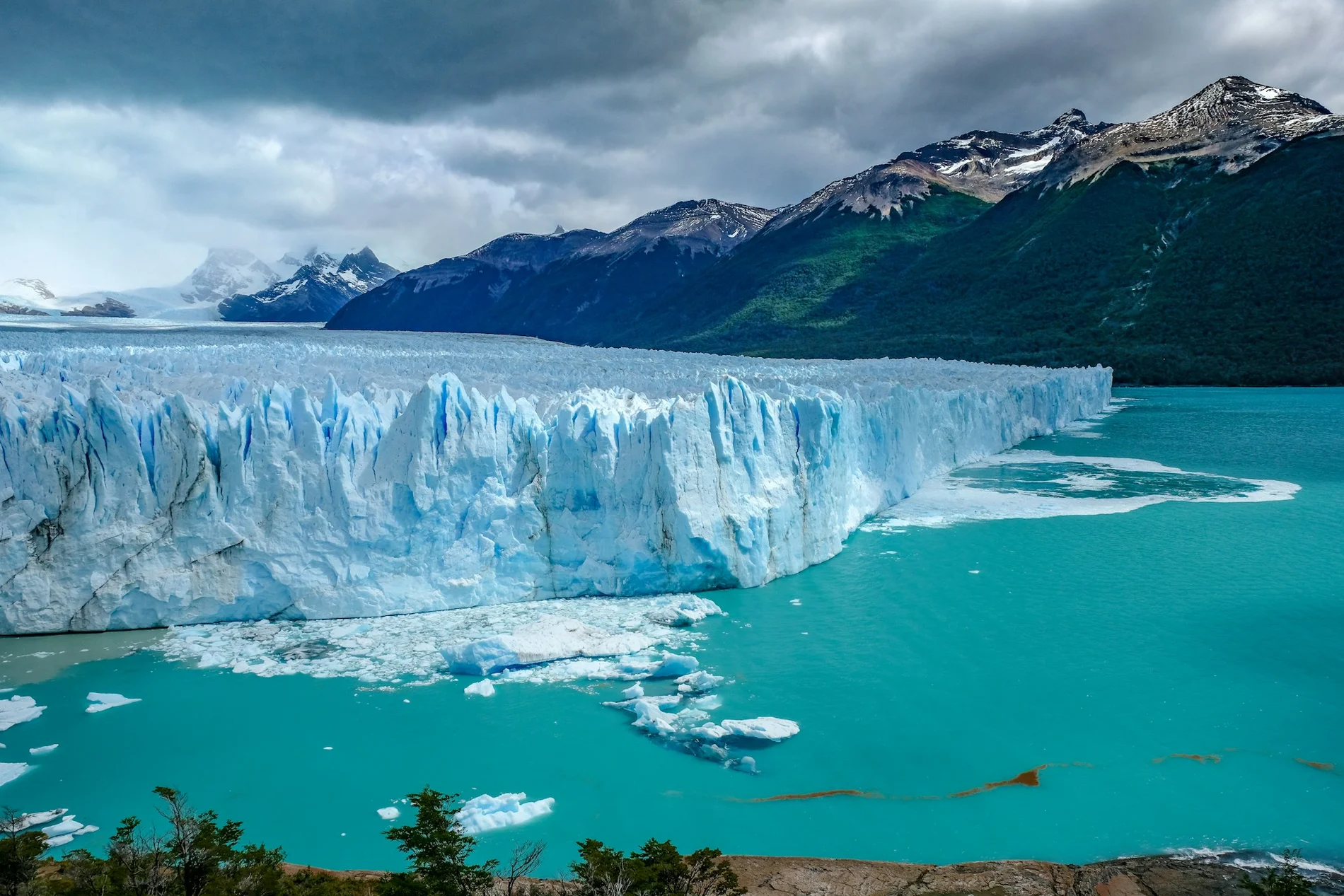
Glaciar Perito Moreno in Parque Nacional Los Glaciares — UNESCO World Heritage site, Argentine Patagonia
Glaciar Perito Moreno, southern sector — one of 47 glaciers within the park

Getting there

How to reach El Chaltén

There are no direct flights to El Chaltén. The journey requires flying to El Calafate and travelling onward by road — a route that is, in itself, part of the experience.

Fly to El Calafate

El Calafate Airport (FTE) is served by direct flights from Buenos Aires (Aeroparque AEP and Ezeiza EZE), Bariloche (BRC), Mendoza, and other Argentine cities. Aerolíneas Argentinas, LATAM, Flybondi and Jetsmart all operate routes. Flight time from Buenos Aires: 3 hours.

Bus along Ruta 40

Regular bus services run from El Calafate bus terminal to El Chaltén. Journey time: approximately 3 hours. Chaltén Travel and TAQSA operate daily departures. Book in advance during high season (December–February). Buses meet incoming flights when timed correctly.

Private transfer or hire car

The road from El Calafate to El Chaltén is fully paved and passes through extraordinary steppe scenery, including views of Lago Argentino. A hire car gives maximum flexibility. Private transfers can be arranged through the hotel — mention it when reserving.

Airlines serving El Calafate

  • Aerolíneas Argentinas — Buenos Aires (AEP/EZE), Bariloche, Mendoza, Córdoba
  • LATAM — Buenos Aires (EZE)
  • Flybondi — Buenos Aires (EZE), Mendoza
  • Jetsmart — Buenos Aires (EZE), Santiago de Chile

Distances and journey times

  • El Calafate → El Chaltén: 220 km, 3 hrs by road
  • Buenos Aires → El Calafate: 3 hrs by air
  • Bariloche → El Calafate: 2 hrs by air (or 2 days overland via Ruta 40)
  • Torres del Paine (Chile) → El Chaltén: 4–5 hrs via border crossing

When to visit

The seasons

El Chaltén operates from October to April. Each part of the season has a distinct character — there is no single "best time," only the right time for what you are looking for.

October — November

Recommended

Early season

The village wakes up. Snow lingers on the higher trails early in October, but by November the paths are clear and the wildflowers are extraordinary — particularly the calafate bushes and the yellow amancay. Visitor numbers are low, accommodation is more available, and the light — with the sun still relatively low — is exceptional for photography.

Weather is highly variable. Wind can be strong. But the rewards for those willing to adapt to conditions are considerable.

Visitors Low to moderate. Good trail availability.
Weather Variable. Cold mornings, occasional snowfall at altitude in October.
Daylight 15–17 hrs in November. Long days for extended hikes.

December — February

Peak season

High summer

The longest days — up to 19 hours of light in late December. The Fitz Roy in golden light at 10 pm is one of Patagonia's great spectacles. Trails are busy, the village is at full capacity, and accommodation must be booked months in advance. January is the peak of the peak.

The trade-off: this is also the windiest period, and the Fitz Roy can be obscured by clouds for days at a time. Patience and flexibility are essential.

Visitors High. Book 3–6 months in advance for January.
Weather Warmest, but also windiest. Expect rapid changes.
Daylight Up to 19 hrs. Sunrise before 6 am, sunset after 9 pm.

March — April

Highly recommended

Autumn

Increasingly the preferred season for experienced travellers. The lenga beech turns from green through gold to deep red-orange, transforming the valleys into something extraordinary. Winds calm after the summer peaks. Skies are often clearer than in midsummer. The Fitz Roy against an autumn forest is one of Patagonia's signature images.

Visitor numbers drop sharply after February. March in particular offers the combination of good weather, autumn colour, and genuine quiet on the trails.

Visitors Moderate in March, low in April. Excellent trail availability.
Weather Calmer winds than summer. Cooler temperatures. Some rain.
Daylight 12–15 hrs. Shorter days, but better light quality.

May — September

Hotel closed

Patagonian winter

Los Cerros closes for the winter. The village reduces to a community of a few hundred residents. Snow covers the mountains and the higher trails become inaccessible without mountaineering equipment. Some lower trails remain walkable; the winter light can be spectacular.

A small number of specialist operators offer winter mountaineering expeditions. For everyone else, El Chaltén in winter is something to look forward to from a warmer place.

Hotel Los Cerros is closed. Limited accommodation available in the village.
Trails Higher routes closed or dangerous. Some valley walks accessible.
Daylight As few as 8 hrs in June. Cold, often below freezing.

Before you go

Practical information

Trails and park access

Entry fee No entrance fee for any trails in El Chaltén. Brief registration at the park office on arrival in the village — free, two minutes.
Permits Not required for day walks. The Huemul Circuit requires a separate permit — available at the park office.
Camping Free wild camping is permitted in designated areas. Campfires are strictly prohibited — bring a gas stove. Designated campsites: Poincenot, De Agostini, Laguna Torre, Toro.
Trail maps Free at the park entrance. Digital tracks on Wikiloc and AllTrails. Download offline before you go — there is no mobile signal on most trails.
Mobile signal Claro and Personal have coverage in the village. No signal on trails. Carry a downloaded offline map.
Water All streams and rivers are safe to drink from. A filter or purification tablets are optional insurance.

In the village

Currency Argentine pesos (ARS). USD widely accepted. ATMs are unreliable — bring cash from El Calafate or Buenos Aires. Cards accepted at Los Cerros and most restaurants.
Wi-Fi Available at the hotel and most restaurants. Not available on trails. Speed is moderate — sufficient for messaging and navigation, not for streaming.
Gear rental Trekking poles, crampons, and camping equipment available for hire in the village. Several shops on San Martín and Lago del Desierto avenues.
Medical Small medical centre in the village. Nearest hospital in El Calafate. Travel insurance with emergency evacuation cover is strongly recommended.
Supermarkets Two small supermarkets in the village. Stock is limited and expensive. Buy trail food supplies in El Calafate or Buenos Aires if possible.
Language Spanish is the primary language. English spoken at Los Cerros and most tourism-facing businesses in the village.

Questions

Frequently asked questions

The season runs October to April. For fewer crowds and autumn colour, March is ideal. For the longest days, December–January. November offers wildflowers and good availability. There is no universally "best" month — weather is unpredictable throughout the season.

Fly Buenos Aires → El Calafate (3 hrs, multiple daily flights), then bus or transfer El Calafate → El Chaltén (3 hrs along Ruta 40). Total journey time door to door from Buenos Aires is typically 7–9 hours. Los Cerros can arrange a private transfer from El Calafate.

No permits are required for day walks. You register at the park entrance on arrival — free, takes two minutes. The only exception is the Huemul Circuit (4 days), which requires a permit available at the park office. No booking in advance needed.

A minimum of three full days covers the two essential circuits (Fitz Roy and Cerro Torre). Five to seven days is ideal — it gives you flexibility to wait for a clear weather window on the key trails, and time for the panoramic Loma del Pliegue Tumbado route. Ten or more days suits those doing the Huemul Circuit.

To some extent. The shorter walks (Laguna Capri, Mirador de los Cóndores) are accessible to most people. The village itself is small and charming. But El Chaltén is fundamentally a trekking destination — those who do not walk will find the visit shorter and more limited than those who do.

Yes — this is one of the classic Patagonia itineraries. El Calafate (Perito Moreno glacier) + El Chaltén + Torres del Paine in Chile covers the essential Patagonian destinations. Allow at minimum 10–14 days for the combination. Border crossing between El Chaltén and Torres del Paine takes approximately 4–5 hours via the Cerro Castillo border post.

Where to stay in El Chaltén

Los Cerros.
Twenty years at the foot
of the Fitz Roy.

A boutique hotel of 42 rooms, five minutes on foot from the main trailheads. Built for those who take their time in the mountains and want to return to something that matches the landscape.

Artisan breakfast included — served from 7 am for early trail departures Restaurant El Viento — Patagonian cuisine, open for breakfast and dinner Spa and massage treatments — post-trekking recovery Excursions arranged in-house — guided treks, glacier crossings, horse rides 4.7 / 5 on Tripadvisor — 487 verified reviews, Travellers' Choice 2025
Reserve your stay
Los Cerros Boutique Hotel in El Chaltén with the Fitz Roy massif in autumn colours behind
Los Cerros Boutique Hotel

Las Loicas 1 · El Chaltén
5 min on foot from the Fitz Roy trailhead